
The Free AI Tutor That Lowered Grades
Topics: AI at Work & Governance
A free AI tutor sounds like the easiest win in education. Give every student a patient, tireless explainer, built on GPT-4o, trained on the actual course materials, available at 2 a.m. before the exam. A randomized trial at the University of Maryland ran exactly that experiment. The tutor made grades worse.
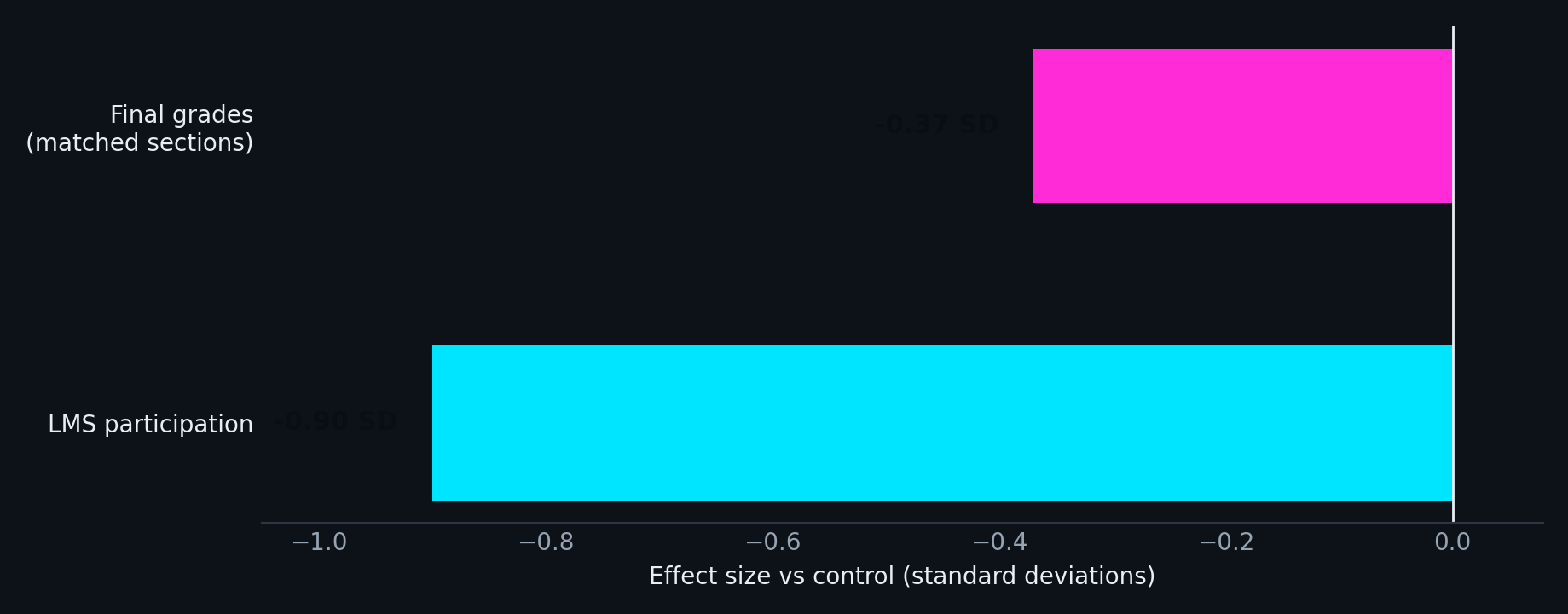
Not slightly worse in a way you can argue with. In the sections that matched up cleanly, final grades fell by 0.37 standard deviations, which the authors translate as about 4 points on a 0 to 100 scale. And the strangest part: most students never opened the tool.
The setup
Researchers randomized course sections, not individual students, across Fall 2025: 2,379 students and 30 instructors. Sections assigned to treatment got the Virtual Study Assistant, a GPT-4o chatbot with retrieval over the course's own materials, embedded directly in the learning platform. Control sections got the same course without it. Because assignment was by section, the results measure what happens when a whole class gets access, which is how these tools are actually deployed.
The result
Final grades in treated sections fell between 0.27 and 0.37 standard deviations depending on the sample, with the like for like comparison at the worse end. Participation on the course platform, logins, activity, engagement, fell by about 0.9 standard deviations, a drop far larger than the grade effect. The classroom didn't get a tutor. It got quieter.
Almost nobody used it, and it didn't matter
Only 14.63 percent of treated students ever used the assistant even once. Yet the losses show up across the treated sections, not just among users. Of the 3,460 questions students did ask, 73.8 percent were requests for information, explanations or worked solutions. Only 11.3 percent were practice or self testing. And 0.7 percent, less than one in a hundred, asked the tutor to comment on their own work.
A tool designed as a tutor was used as an answer machine, and the sections around it quietly disengaged.
Why would non users lose ground? The paper cannot prove the channel, and I won't pretend otherwise. The plausible mechanics are social: when answers are one click away, the perceived value of showing up, doing the reading and struggling in public falls, for everyone in the room. Treat that as interpretation, not as a measured result.
Who paid the highest price
First generation students, those whose parents did not attend college, lost more than twice as much as their classmates. The tool that was supposed to level the field taxed the students with the least academic support at home. That single finding deserves more attention than the headline number.
What the paper shows / what it doesn't
- Shows: in this university, this semester, section level access to this tutor lowered grades and platform participation, with the largest losses for first generation students.
- Doesn't show: that every AI tutor harms learning. One tool, one campus, one term. A tutor designed to refuse direct answers might behave very differently.
- Status: working paper, not yet peer reviewed. Numbers can move in revision.
The bottom line is simple: a tutor that hands over answers is not a tutor, it is a shortcut with a friendly voice. The fix is not less AI in classrooms. It is AI that is graded on what students learn, not on what students click.
Source
Working paper · Not peer reviewedLiu et al., “The Effects of Course-Integrated AI Tutoring on Student Performance and Engagement: A Randomized University Trial.” EdWorkingPaper 26-1598, Annenberg Institute, September 29, 2026. doi.org/10.26300/y3f8-vh05
Every number in this article comes from that paper. Where I interpret, I say so.
Get Facts First, every Sunday
One email a week: the 5 facts that mattered in AI, health and longevity, each checked against the original source. No spam. Unsubscribe in one click.
By subscribing you agree to receive the newsletter. See the privacy policy.