
Myostatin Blockers Cut GLP-1 Muscle Loss. Strength Is Unproven
Topics: Muscle & Body Composition
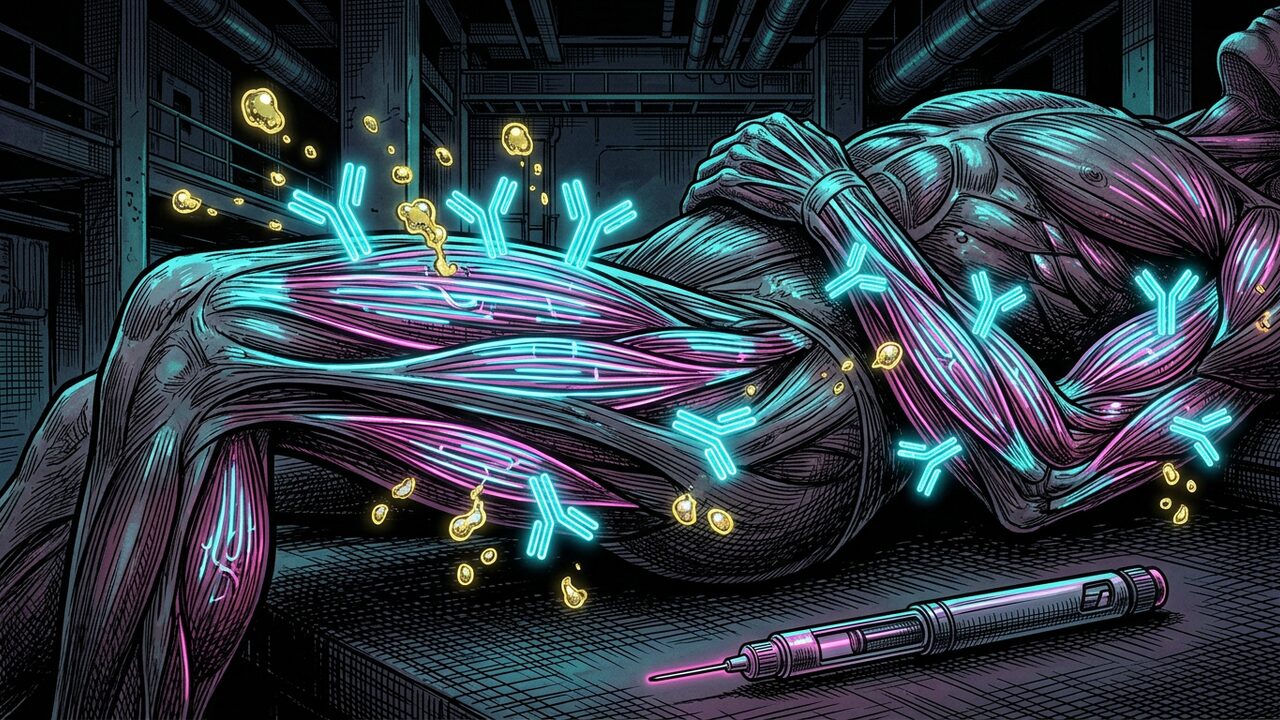
Everyone who starts a GLP-1 drug eventually asks the same question: how much of the weight I lose is muscle? Two very different answers circulated this autumn. A clinic in Vienna says the loss is 80 to 85% fat and that muscle barely moves. Two drug companies say that roughly a third of what their trial patients lost on a GLP-1 drug alone was lean tissue, and that their antibodies can cut that share sharply. Both sides are reporting real data. They are not measuring the same thing, and that gap decides how much this new class of add on drugs is worth.
The reassuring number, and how it was measured
The 80 to 85% figure comes from a poster at the European Congress on Obesity in May, recirculated widely in September. Researchers at a private obesity clinic in Vienna and the Medical University of Vienna looked back at 486 adults treated between 2022 and 2025. Most were women (82%), and most took semaglutide (82%), with smaller groups on liraglutide and tirzepatide. After about 14 months, average weight loss was 9.9%. Fat mass fell by 9.0 kg, roughly 18%. Skeletal muscle fell by 1.2 kg, about 5%. More than 70% of patients kept or increased muscle as a share of body weight.
Three caveats travel with that result. The study is retrospective, with no comparison group and missing data. Body composition was estimated by bioelectrical impedance, which sends a weak current through the body; it is cheap and fast but sensitive to hydration. And an average loss under 10% is modest next to what trial patients reach. The authors' own claim is narrower: muscle changed in proportion to fat.
The less comforting number from controlled trials
Randomized trials scan people with DXA, a low dose X ray that splits the body into fat, lean tissue and bone. In Scholar Rock's EMBRAZE trial, published in Nature Medicine in June, lean mass made up 30.2% of the weight lost by people on tirzepatide plus placebo over 24 weeks. In Regeneron's COURAGE trial, people on semaglutide plus placebo lost 6.6% of their lean mass in 26 weeks, and 7.3% over a full year.
Lean mass is not the same as muscle. It includes organs, water and everything else that is not fat or bone, which is why a clinic's skeletal muscle estimate and a trial's lean mass figure can both be accurate while pointing in different directions. Neither one is a measure of strength.
What the antibodies did
Both companies are betting on myostatin, a protein the body uses to cap muscle growth. Block it, the theory goes, and muscle holds on while the GLP-1 drug removes fat.
EMBRAZE randomized 102 adults with overweight or obesity, most of them women, to tirzepatide plus apitegromab or tirzepatide plus placebo. At 24 weeks, the apitegromab group had lost 1.6 kg of lean mass against 3.5 kg with placebo, a difference of 1.9 kg that the authors describe as 54.9% retention. Total weight loss was similar, 11.2 kg against 12.5 kg. With the antibody, 85.3% of the weight lost was fat, against 69.5% with placebo. Side effects were comparable. The trial used a lenient 20% significance threshold, typical of proof of concept work.
COURAGE is far larger: 975 people with obesity across two parts, presented at the European Association for the Study of Diabetes meeting and announced by Regeneron on October 1, with the paper in press at The Lancet. In the year long part, which enrolled 376 people, semaglutide with placebo cost 7.3% of lean mass. Adding the higher of two low doses of trevogrumab cut that loss to 4.2%, which Regeneron calls 42.5% preservation. The smaller dose brought it to 5.8%, a difference that did not reach statistical significance. In an MRI substudy of 76 people, which measures thigh muscle directly rather than lean mass in general, trevogrumab prevented roughly 70% of the muscle loss seen with semaglutide alone.
The antibodies keep kilograms of lean tissue on the scan. No trial has yet shown that those kilograms make anyone stronger.
Then the fine print. The most important sentence in the EMBRAZE paper sits among the exploratory results: no notable differences in physical function, measured with handheld force tests and repeated chair stands, between the two groups. Lean mass moved; function did not, at least over six months in fairly young adults whose average age was in the early forties.
COURAGE has a safety story too. A triple combination arm that added a second antibody, garetosmab, preserved the most lean mass but brought more serious adverse events and discontinuations, muscle spasms in 41% of patients, and both of the trial's deaths, which have not been causally linked to treatment. The trevogrumab arms looked comparable to semaglutide alone. One finding is more intriguing: in the first part, people who stopped semaglutide and then took trevogrumab for 26 more weeks ended slightly above their starting lean mass, at plus 0.4%, while the placebo group stayed 2.4% below. That hints the drug might shape what comes back during weight regain, which tends to be mostly fat. A hint, not proof.
The RNA idea, still in mice
A third approach skips muscle altogether. Researchers at Northwestern, working with Ionis Pharmaceuticals, built an antisense RNA drug that silences ZFP423, a gene that stops white fat from turning into energy burning beige fat. In the PNAS paper published September 25, obese mice given the RNA drug alongside semaglutide lost about 5.5% of their lean mass, against about 10% with semaglutide alone, and ended with roughly half the body fat. The key combination experiment lasted 21 days, with five mice per group. Next step: human cells. A mechanism worth watching, not a treatment.
What comes next
Regeneron plans a new phase 2 trial of trevogrumab with GLP-1 based drugs in older adults with obesity and low muscle mass or strength, the people for whom lost muscle actually costs function. Pills are coming too: one candidate, covered in our look at the Sironax phase 2 trial, is halfway through enrollment with no efficacy data yet.
What it shows / what it doesn't
- Shows: in two randomized phase 2 trials, myostatin antibodies reduced the lean mass lost on semaglutide or tirzepatide without changing total weight loss much.
- Shows: a Vienna clinic cohort found 80 to 85% of weight lost was fat, with muscle changing in proportion to fat.
- Doesn't show: any gain in strength or physical function. EMBRAZE found none, and COURAGE has not reported function as an outcome.
- Doesn't show: that the ZFP423 RNA drug works in people. All data so far come from mice.
- Status: one peer reviewed trial (EMBRAZE), one conference presentation with a paper in press (COURAGE), one retrospective conference poster, one peer reviewed mouse study.
I read the 80 to 85% headline as good news with an asterisk. For a typical patient losing a moderate amount of weight, the muscle panic has been overblown, and the Vienna data fit that. But the trials show that when weight comes off fast and far, close to a third of it can be lean tissue, and for a frail 75 year old that is not a cosmetic detail. Myostatin antibodies clearly change the scan. My guess is that they end up as a niche add on for older or sarcopenic patients rather than something every GLP-1 user takes, and only if the next trials show people climbing stairs better, not just weighing in better. Until then, the oldest muscle preservation tool, the one nobody can patent, is still resistance training, a conversation worth having with a doctor before the weight starts coming off.
Sources
Peer reviewed / Conference abstract / Press releaseRegeneron Pharmaceuticals, Phase 2 COURAGE Trial Confirms Trevogrumab Prevents Lean Mass and Muscle Loss During GLP-1 Receptor Agonist induced Weight Loss, press release, October 1, 2026. investor.regeneron.com
European Association for the Study of Diabetes, press release on the COURAGE trial (EASD 2026, Milan; in press with The Lancet), October 1, 2026, as published by News Medical. news-medical.net
Pratley RE et al. Apitegromab for lean mass preservation during tirzepatide induced weight loss: a randomized, double blind, placebo controlled phase 2 trial. Nature Medicine 32, 2673 to 2678, published June 8, 2026. ClinicalTrials.gov NCT06445075. nature.com
European Association for the Study of Obesity, Study suggests muscle mass preserved after obesity drug treatment (Frohner, Jürets, Itariu; ECO2026 poster), May 13, 2026. eurekalert.org
Thorne AK et al. An RNA thermogenic therapy to preserve lean mass and enhance metabolic health during GLP-1 weight loss. PNAS 123(40), published online September 25, 2026. pnas.org
Northwestern University, RNA therapy may help preserve muscle during GLP-1 weight loss, September 19, 2026. news.northwestern.edu
Get Facts First, every Sunday
One email a week: the 5 facts that mattered in AI, health and longevity, each checked against the original source. No spam. Unsubscribe in one click.
By subscribing you agree to receive the newsletter. See the privacy policy.