
The First PCSK9 Pill Is Here. The Proof Still Comes From a Shot
Topics: Heart & Lipids
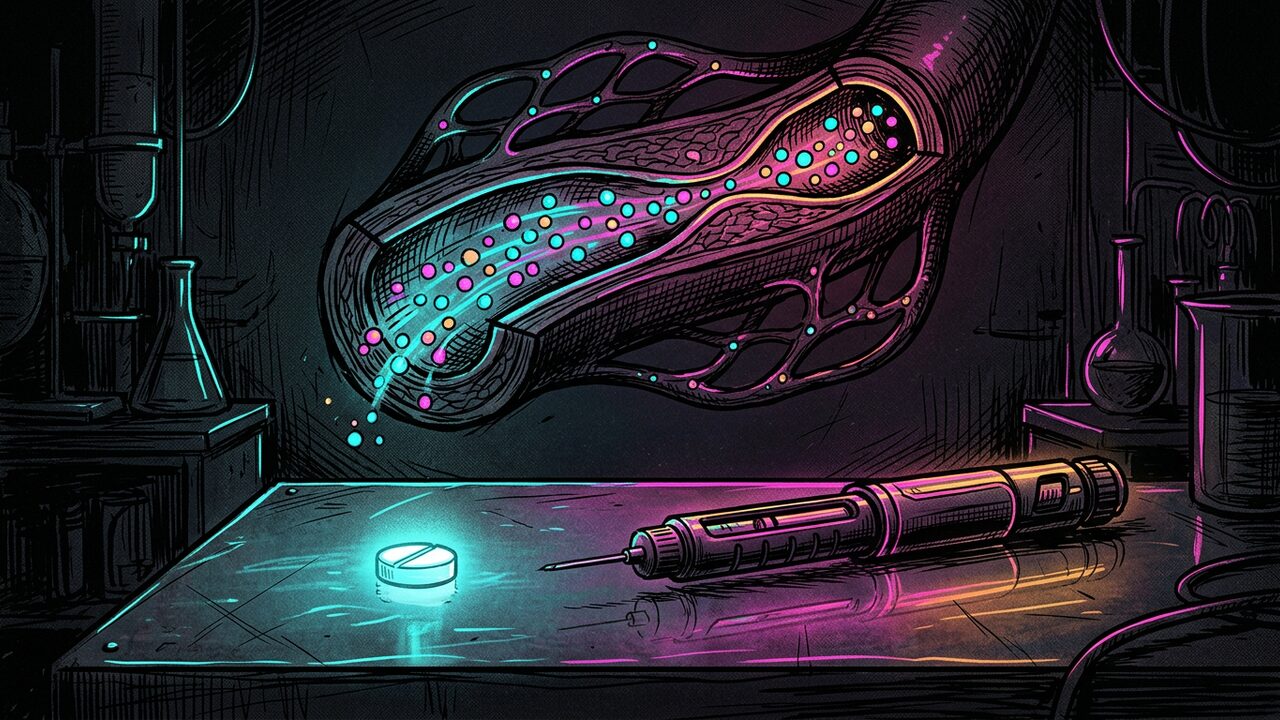
For a decade, the most powerful way to lower LDL cholesterol after a statin came with a needle. This summer that changed. On July 17, the Food and Drug Administration announced it had approved Merck's enlicitide, sold as Lipfendra, the first PCSK9 inhibitor that comes as a daily tablet instead of an injection. Six weeks later, investigators behind Amgen's injectable PCSK9 drug, evolocumab, reported that in people who had never had a heart attack or stroke, those on the drug were 20% less likely to die over about five years.
Read together, the two stories say something simple and slightly awkward. The pill is new; the proof that this class of drug saves lives comes from the shot. And both rest on the same bet cardiology has been making for decades: lower the particles that carry cholesterol into artery walls, and fewer people have heart attacks.
What the FDA approved, and on what evidence
PCSK9 is a liver protein that destroys the receptors the liver uses to pull LDL out of the blood. Block it, and more receptors survive to do the cleaning. Until now that meant antibodies injected every few weeks. Enlicitide is a macrocyclic peptide, a ring shaped molecule engineered to survive the gut and reach the same target.
The approval rests on two phase 3 trials with 3,207 adults who were already on the most statin they could tolerate. In CORALreef Lipids, people with heart disease or at high risk of it started at an average LDL of 96 mg/dL; after 24 weeks, LDL was 56% lower on enlicitide than on placebo. In CORALreef HeFH, people with an inherited form of high cholesterol started at 119 mg/dL and saw a 59% placebo adjusted reduction. According to Merck, apolipoprotein B, the protein that marks each atherogenic particle, fell by about half in both trials, 50% and 48%.
Side effects in the larger trial were similar to placebo. In the familial trial, diarrhea (7% versus 2%) and dizziness (9% versus 4%) were more common on the drug, and dropout for side effects was similar in both arms. Notably, people already taking a PCSK9 drug were excluded, so the trials say nothing about switching from a shot to the pill.
What the approval does not cover matters as much. The label is for lowering LDL. Merck's own release says it plainly: "It is not yet known if LIPFENDRA can reduce the risk of cardiovascular morbidity and mortality." That answer will come from CORALreef Outcomes, which has enrolled more than 14,500 people. Until it reports, the pill is approved for a number, not for a heart attack prevented.
The shot that moved the death rate
VESALIUS-CV is the trial that makes the number worth chasing. It enrolled 12,257 people with atherosclerosis or high risk diabetes but no prior heart attack or stroke, all with LDL of at least 90 mg/dL (or the equivalent in non HDL cholesterol or apoB) despite their usual treatment. Half got evolocumab, half placebo, for a median of 4.6 years.
The main result, published in the New England Journal of Medicine in November 2025, was a lower rate of coronary death, heart attack or ischemic stroke: 6.2% at five years on evolocumab versus 8.0% on placebo, a hazard ratio of 0.75. The mortality analysis, published in Circulation on August 31, 2026, found 434 deaths on evolocumab against 539 on placebo, five year rates of 7.9% and 9.7%. That is the 20% relative reduction in the headlines. In absolute terms it is 1.8 percentage points, which by my arithmetic means treating roughly 55 people for five years to prevent one death.
A 20% cut in deaths sounds like a slogan. Over five years it is about one life for every 55 people treated, which in prevention is a strong result.
Three caveats travel with that number. Mortality was a prespecified analysis, not a primary endpoint, so it supports the main result rather than standing alone. Deaths from noncardiac causes were also lower, but that difference was not statistically firm (hazard ratio 0.85, with a confidence interval touching 1), and the authors' modeling attributes most of it, about 78%, to heart attacks and strokes that never happened. And the trial was funded by Amgen, which sells the drug. If you want a refresher on why relative and absolute risk tell such different stories, I wrote a short guide to reading a health study.
Why apoB and LDL stay the target
Put the two results side by side and the logic is the old one. Evolocumab and enlicitide block the same protein to lower the same particles. The outcome data exist for one; the bet is that they transfer to the other because what matters is the number of cholesterol carrying particles, not the delivery method. That bet has a strong track record with LDL lowering drugs. It has also failed elsewhere: the Lp(a) drug pelacarsen lowered its target and missed its outcome. A biomarker earns trust drug by drug.
There is a live argument about which number to count. LDL cholesterol measures how much cholesterol the particles carry; apoB counts the particles themselves, one apoB molecule per particle. The 2026 American dyslipidemia guideline brought apoB into US practice, saying it may be a more accurate risk marker than LDL in people with diabetes, high triglycerides, cardiovascular kidney metabolic syndrome or known heart disease who have already reached their LDL goals. Critics say that is too timid. In September, a team led by Allan Sniderman reported in the Journal of Clinical Lipidology that, in US national survey data, many people who reach their LDL targets do not reach the guideline's apoB targets, and that in the UK Biobank apoB was the more precise marker of risk even at LDL goal. They called the guideline's claim of minimal discordance "an apparent consequential error."
For the drugs in this story, the debate matters less than it sounds. Both lower LDL and apoB together, by about half or more. Where the choice of marker bites is in deciding who still needs more treatment after a statin, and that is exactly the decision a swallowable PCSK9 inhibitor will make more common.
What the evidence shows / what it doesn't
- Shows: enlicitide, the first oral PCSK9 inhibitor, lowered LDL by 56% to 59% versus placebo at 24 weeks in 3,207 adults already on statins, with apoB down by about half.
- Shows: injectable evolocumab cut first major cardiovascular events and was associated with 20% fewer deaths (7.9% versus 9.7% at five years) in high risk people without a prior heart attack or stroke.
- Doesn't show: that enlicitide prevents heart attacks, strokes or deaths. Its outcomes trial has not reported, and there are no head to head data against the injections.
- Status: FDA regulatory decision and company press release for enlicitide; peer reviewed randomized trial and prespecified analysis for evolocumab, both industry funded.
I find the pill more interesting than the death statistic, and not because of the chemistry. The evolocumab result confirms what the field already believed: get the particles low enough, early enough, and people live longer. The bottleneck has never been the biology. It has been that most eligible people never start a twice monthly injection, or stop. A tablet removes one excuse, though price and insurance coverage may decide more than the format. My guess is that CORALreef Outcomes will look a lot like the injectable trials, because the LDL curve looks the same. But plenty of people expected Lp(a) lowering to pay off before HORIZON, so I will wait for the events before calling it.
Sources
Regulatory decision · Press release · Peer reviewedU.S. Food and Drug Administration, "FDA Approves First Oral PCSK9 Inhibitor to Lower LDL Cholesterol in Adults with High Cholesterol," news release, July 17, 2026. fda.gov
Merck, "Merck's LIPFENDRA (enlicitide) is the First and Only Once Daily Oral PCSK9 Inhibitor Approved by the U.S. FDA," news release, July 16, 2026. merck.com
Bohula EA et al., "Evolocumab in Patients without a Previous Myocardial Infarction or Stroke," New England Journal of Medicine, published online November 8, 2025. nejm.org
Giugliano RP et al., "Effects of evolocumab on mortality outcomes in patients without previous myocardial infarction or stroke: a prespecified analysis of the VESALIUS-CV randomized clinical trial," Circulation, published online August 31, 2026. eprints.gla.ac.uk
American College of Cardiology and American Heart Association, guideline news release on the 2026 dyslipidemia guideline, March 13, 2026. newsroom.heart.org
Cole J et al., "Does the evidence support the ACC/AHA multisociety recommendation to measure apoB only after LDL-C and non HDL-C are at target?" Journal of Clinical Lipidology, available online September 18, 2026. doi.org
The figure of about 55 people treated for five years per death avoided is my own arithmetic from the published five year rates.
Get Facts First, every Sunday
One email a week: the 5 facts that mattered in AI, health and longevity, each checked against the original source. No spam. Unsubscribe in one click.
By subscribing you agree to receive the newsletter. See the privacy policy.